How Likely Are You To See A Bear In Jasper?
An honest answer to bear sighting odds in Jasper National Park, where and when bears are actually seen, and how a guided wildlife tour changes the numbers.
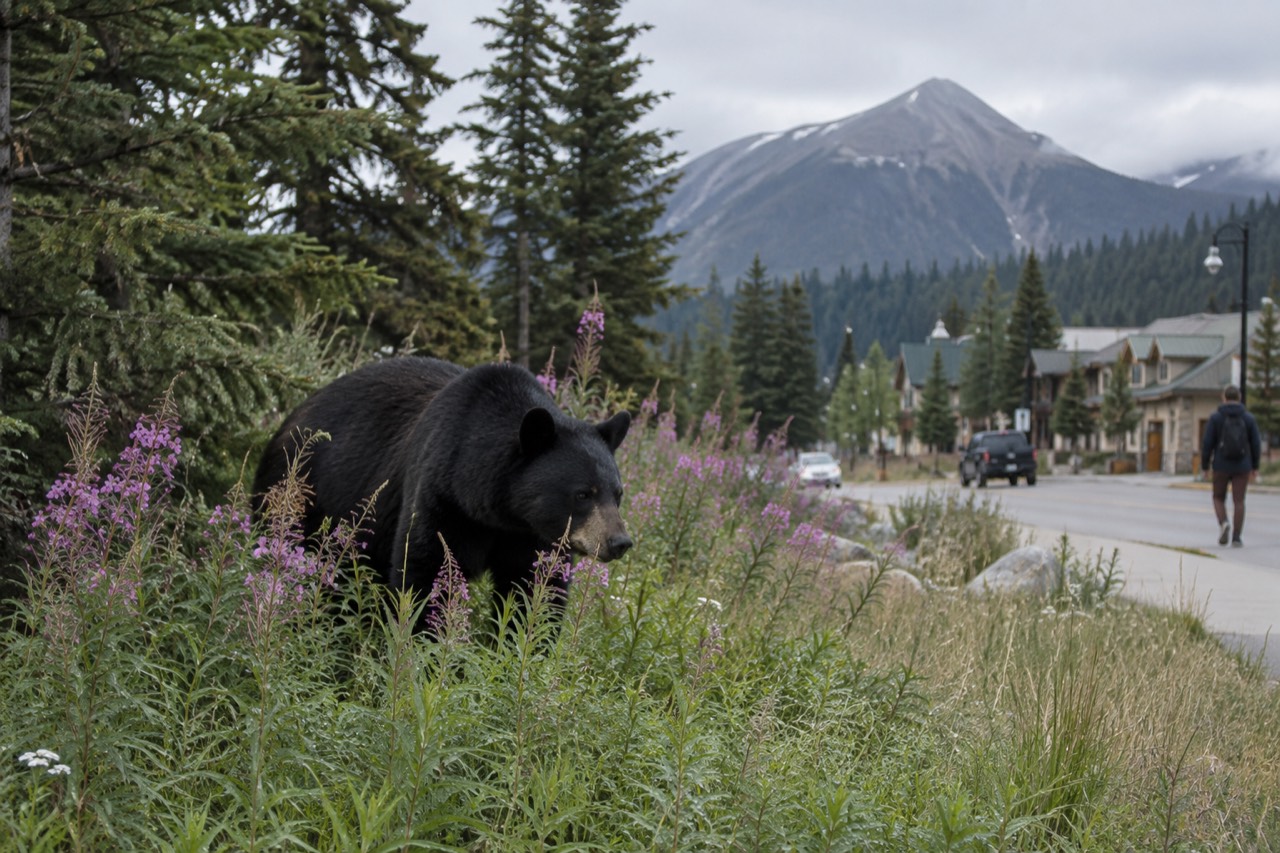
How Likely Are You To See A Bear In Jasper?
Nobody can give you a precise percentage, because Parks Canada publishes no bear-sighting rate or park-specific bear count. What is verifiable is that both black bears and grizzly bears live in Jasper, on the official mammal list, and visitors do see them, mostly from a vehicle at dawn or dusk along the Maligne Valley, the Icefields Parkway and the Yellowhead corridor. Your odds rise with time, the right hours, and a knowledgeable guide.
That answer will disappoint anyone hoping for a number, but it is the only honest one. Plenty of travel content throws figures around: "a 90 percent chance on this tour", "Jasper has 300 grizzlies". None of that comes from Parks Canada. The official mammal list for Jasper National Park, published on the park's nature pages, names bears alongside elk, deer, moose, caribou, bighorn sheep, mountain goats, coyotes, wolves, beavers, pine martens, lynx, porcupines, cougars, snowshoe hares and wolverines. That is the extent of what a primary source will commit to: bears live here, in a 11,228 square kilometre park that is the largest and most northerly of the Canadian Rocky Mountain national parks.
What the official record does support is a pattern, and the pattern is more useful than a fake statistic. Bears in Jasper are seen most reliably in three kinds of places: valley-bottom roads where food plants grow close to the asphalt, burn areas where regenerating forest produces berry crops and new browse, and lake and river edges at the hours when traffic is light. The Maligne Lake Road is the classic example of the first type. It runs the full length of the Maligne Valley, one of the areas the 2024 wildfire burned, and regenerating ground along that corridor is exactly the early-successional habitat bears feed in.
There is also a historical case worth knowing. The trail beyond Sunwapta Falls passes through the Chaba River burn area, the legacy of a 1967 wildfire, and Parks Canada describes it today as one of the best bear and moose habitats in the park. Nearly sixty years of regrowth turned a burn into prime bear habitat. The 2024 Jasper Wildfire, at 32,722 hectares, reset a much larger area, and the same ecological logic applies: the burn visible along the Athabasca valley south of town, around the townsite's southwest edge and up the Maligne road corridor is becoming feeding ground, and bears are using it.
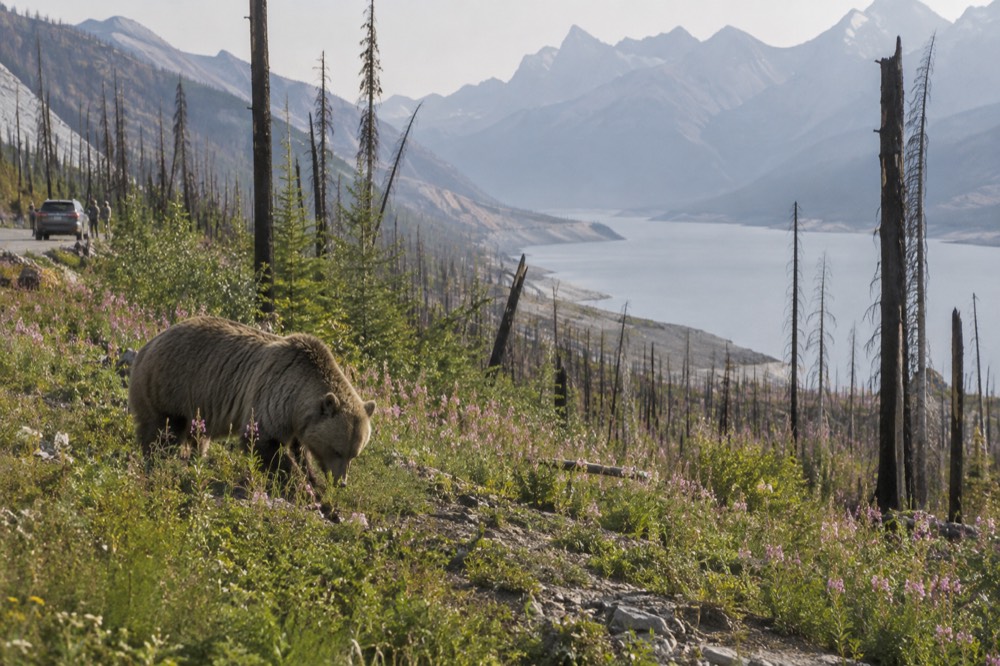
For most visitors, the practical question is not "what is the probability" but "what do I do to be in the small group that sees one". That is a question with real answers: hours, routes, patience, and whether you have someone with you who can read the landscape. If you want a fuller rundown of every guided option, the Jasper wildlife tours guide covers the whole category, and we get into the tour question later in this article.
Where bears actually live in Jasper
Bears range across the whole park, but sightings cluster in valley bottoms: the Maligne Valley, the Athabasca and Sunwapta river corridors along the Icefields Parkway, and the low country around Pyramid, Patricia and Annette lakes near town. Parks Canada lists bighorn sheep, mountain goats, coyotes and deer as commonly sighted along the Icefields Parkway, and bears move through the same feeding areas. Elevation and berry crops decide where, not luck.
The geography matters more than most first-time visitors expect. Jasper is not a zoo with a bear enclosure; it is 11,228 square kilometres of mostly wild country, and roughly 97 percent of the park is maintained in a natural state with limited infrastructure. A bear's home range is enormous, and on any given morning most of the park's bears are nowhere near a road. The ones you see are the ones feeding close to the corridor you happen to be driving, which is why the same few roads produce most of the sightings.
The Maligne Lake Road deserves its reputation. It is 44 km of valley-bottom driving through the Maligne drainage, past Medicine Lake, ending at the Maligne Lake boathouse area. The road itself has no seasonal closure, so it carries wildlife-viewing traffic year round, and the burned and regenerating slopes along it concentrate new growth. Medicine Lake is worth stopping at for its own sake: it has no visible outflow, drains through sinkholes in its bed and resurfaces 16 kilometres downstream near Maligne Canyon, a system Parks Canada calls one of the largest known sinking rivers in the Western Hemisphere. But the pullouts along the road are where binoculars come out.
One caution belongs here, because Maligne Canyon tours are sold on booking platforms even though the canyon is shut. Maligne Canyon is closed to all access for the 2026 season, including winter access for winter recreation, because of post-wildfire slope instability. A canyon ice walk cannot legally run while that closure stands, and no listing makes it so. Check the Parks Canada bulletins page at https://parks.canada.ca/pn-np/ab/jasper/bulletins before you plan around any Maligne Canyon product. The canyon's geology is still real and worth knowing: it is more than 50 metres deep, two metres across at some points, and carved into limestone laid down about 365 million years ago. It is simply not somewhere a visitor can currently go.
The Icefields Parkway is the other major corridor. It runs 232 km between Lake Louise and the Jasper townsite, and its lower reaches pass through the Athabasca valley, where the 2024 burn is visible. The parkway does not close for winter, though snow tires or chains are required from 1 November to 31 March and there are no winter services along it. In summer it is one of the drives where a bear at the roadside is a realistic hope, especially in the first and last hours of daylight. A park pass is legally required to drive it, and Parks Canada charges admission per person: Adult $12.25 CAD per day, with a Family/Group rate of $24.50 CAD covering up to seven people in one vehicle. Check the current figures on the Parks Canada fee page at https://parks.canada.ca/pn-np/ab/jasper/visit/tarifs-fees, because fees are reviewed annually.
If you want to go deeper on the corridor question, the piece on where to see wildlife in Jasper National Park maps the specific valleys and pullouts. For the Icefields Parkway itself, the Icefields Parkway tours guide covers the drives and the guided options along it.
When your odds are highest
The two variables you control are season and hour. Early morning and the last two hours before dusk outperform midday, because bears feed at the edges of the day and avoid traffic. Spring through early summer is the strongest season, when bears are on valley-bottom green-up after den emergence; late summer and autumn add berry feeding and pre-denning foraging. Peak-season bears also move to cooler hours as daytime warms.
Hour of day is the single biggest lever, and it is free. The visitors who see bears are overwhelmingly the ones on the road before 8 am or out after 6 pm. Midday, bears retreat to shade and cover, and the roadside fills with people, which pushes animals further from the asphalt. This is why the design of a good wildlife tour matters: it puts you in the right habitat at the right hours with someone who knows the difference between a likely meadow and an empty one.
Season shapes what the bears are doing. Spring brings bears down to the valley bottoms for the first green growth, and that is when roadside sightings are easiest, because the food is low and close to the roads. In late summer and autumn, berry crops pull bears onto slopes and into burn regrowth, and the feeding is intense as they build fat for winter. Jasper's climate normals, 1991 to 2020 from Environment and Climate Change Canada, give a sense of the year's shape: snowfall averages 21.2 cm in January and 17.9 cm in December against essentially none in June through August, with July the warmest month at a 23.4 degree daily maximum. Winter bear sightings are effectively zero: bears den through the cold months, and the winter wildlife season belongs to elk, sheep, goats, wolves and coyotes.
| Season | Bear behaviour | Realistic sighting context |
|---|---|---|
| Spring (April to June) | Den emergence, valley-bottom green-up feeding | Best roadside odds of the year, low-elevation meadows |
| Summer (July to August) | Feeding shifts to cooler hours, berries ripen | Early morning and evening only; midday odds collapse |
| Autumn (September to October) | Intense pre-denning foraging, berry and pine crops | Good odds in burn regrowth and valley bottoms |
| Winter (November to March) | Dens | Essentially no bear activity; other wildlife instead |
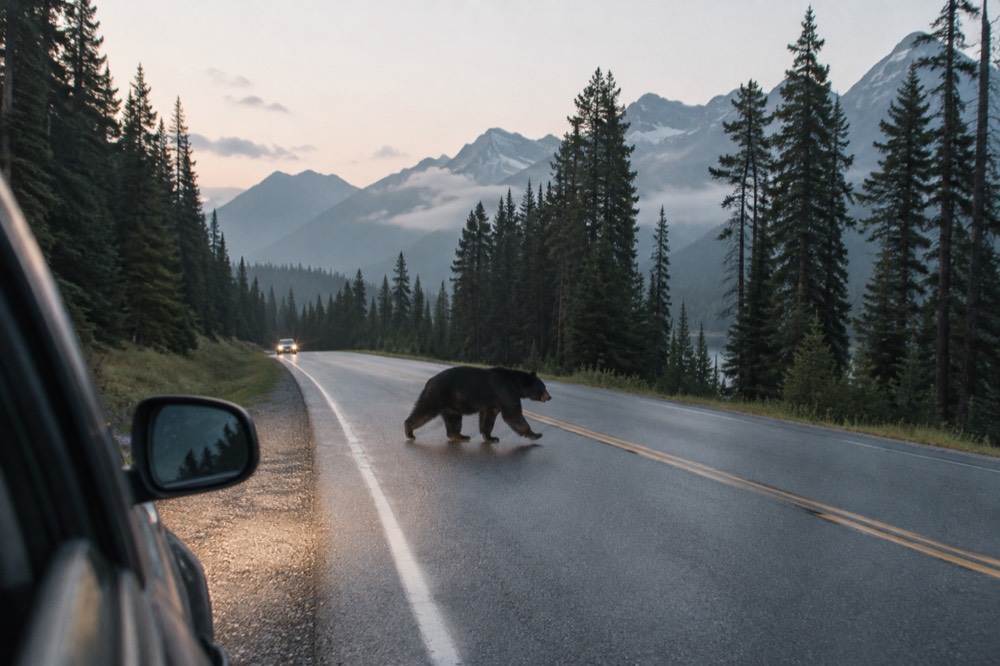
The tour built around this exact logic is the Morning or Evening Wildlife Watch, a 3-hour run from $68.57 with hotel pickup, rated 4.6 across 1,089 reviews and including free cancellation. It targets the shoulder hours by design, and its confirmed stops include Pyramid Lake and The Whistlers summit. Whether it is worth booking is really a question of whether you would otherwise be in the right habitat at 7 am, and most visitors would not.
Do you actually need a tour to see a bear?
No, and plenty of patient visitors see bears from their own car on the Maligne Lake Road or the Icefields Parkway. A tour is not selling access: a park pass is the only authorization needed to travel anywhere in Jasper, and there is no timed entry, no reservation corridor and no mandatory shuttle anywhere in the park. What a tour adds is hours, habitat knowledge and a trained eye, which together do more for your odds than random driving.
It is worth being blunt about the structural facts, because a lot of Banff advice gets imported into Jasper pages by mistake. Jasper has no shuttle system, no reservation window and no timed entry for any attraction. The only authorization to travel anywhere in the park is a Park Pass, which is legally required, charged per person and displayed on your dash. So a wildlife tour in Jasper is never selling you access you could not otherwise buy. What it sells is interpretation and timing, and those are genuinely worth money.
The interpretation part is bigger than it sounds. A guide who works the valley every day knows which cut banks held a grizzly yesterday, which meadow is producing clover this week, and how to read the behaviour of other animals: ravens over a carcass, elk heads all turned the same direction. That knowledge is why the same hours and the same roads produce very different results for different people. It is also why an interpretive walk, rather than a drive, is a different product with a different appeal: you are slower, quieter and in the habitat rather than looking at it through glass.
The Ultimate Jasper Nature Walk is the roster's example of that: a 3-hour interpretive walk from $63.38, rated 4.6 across 15 reviews, with free cancellation. The trade-off is honest. A walk covers a fraction of the ground a vehicle tour does, so it is not a maximise-your-odds play. What it does is put a naturalist between you and the landscape, and for many visitors that is the version of the experience they actually want. The full range of options, including winter wildlife products and longer valley tours, is laid out in the Jasper wildlife tours guide.
The rules that decide whether you should stop
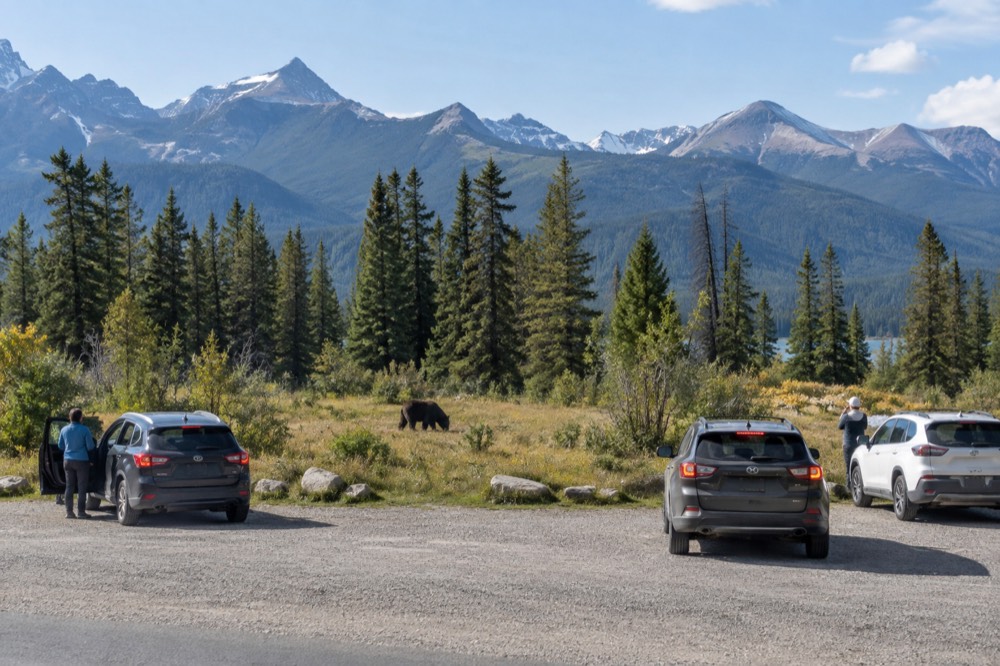
Parks Canada's rules are short and enforceable: stay 30 metres from elk, deer and moose, stay 100 metres from bears and other carnivores, and treat roadside wildlife viewing as a restricted activity, meaning stay in your vehicle, pull over only where it is safe, keep it brief and move on if a jam develops. Feeding, petting, enticing or pursuing any wild animal is an offence. The maximum penalty under the Canada National Parks Act is $25,000.
These rules are not fine print; they are the difference between a good sighting and a dangerous one, and they apply to every visitor whether guided or not. The distances are worth internalising in physical terms: 30 metres is three bus lengths, 100 metres is ten. A telephoto lens, not your feet, closes that gap. The full text lives on the park's wildlife safety page at https://parks.canada.ca/pn-np/ab/jasper/securite-safety/faune-wildlife, and it is the authority on this subject, not any tour operator's marketing.
The roadside rules matter because a roadside bear creates a roadside crowd, and the crowd is the hazard. Parks Canada's guidance is to slow down, use hazard lights, pull over only where it is genuinely safe, never stop in a driving lane, observe and photograph and then move on, and leave immediately if traffic starts to bunch up. A guided tour handles this discipline for you: the driver knows the legal pullouts, keeps the group in the vehicle, and moves the vehicle rather than letting the group drift toward the animal. That is an underrated part of what the ticket buys.
On foot, the rules extend to prevention: travel in groups, make noise, remove your headphones, carry bear spray and know how to use it, and if you meet wildlife, back away and return the way you came. Aggressive encounters are reported to Parks Canada Dispatch at 780-852-6155. Drones are prohibited park-wide, with fines up to $25,000, which closes off the other shortcut people sometimes imagine. If you are weighing the spray question specifically, the bear spray guide for Jasper covers it in detail.
One more honesty note, because it matters to how you read any tour listing: a sighting is never a guarantee, and no tour on this site will be presented as one. Parks Canada describes what lives here and how to behave around it; the animals do the rest. A listing that promises a bear is making a promise no operator can keep.
What a sighting is actually like, and what it says about Jasper
Most Jasper bear sightings are brief and calm: a black bear grazing a roadside meadow, a grizzly at distance through binoculars, an animal that ambles into the trees while you watch from the car. They are memorable because they are ordinary, a wild animal feeding in its own habitat. The visitors who see the most are the ones who spend the most hours in the right valleys at the right times, which is the logic behind a guided wildlife product.
The honest odds conversation usually ends up being about expectations. If you drive the Maligne Valley once, at noon, in two hours, you might see a bear and you might see nothing. If you are out at dawn several days running, with someone who knows where the feeding grounds are, your odds compound with every hour. Time in habitat is the real variable, and everything else, tours included, is a way of buying more effective hours.
That last point is the quiet information gain most first pages of search results miss. Burn ecology is why the Chaba area near Sunwapta Falls, 54 km from Jasper on the Icefields Parkway, is such strong bear habitat today, and the 2024 burn is running the same process across a much larger footprint. Regrowth is not scenery; it is a food web, and bears are at the front of the queue for it. Whitebark pine restoration planting is under way in the burn, and native moth larvae have already appeared in numbers in the recently burned ground, which is exactly the kind of early regrowth signal ecologists watch for.
Combining bear odds with the rest of the Maligne Valley
If seeing a bear is the priority but not the only goal, the strongest single product is a full Maligne Valley tour that includes the lake cruise: wildlife hours, valley-bottom driving and Spirit Island in one day. The Wildlife and Sightseeing Tour with Maligne Cruise runs 6 hours from $169.04 with hotel pickup, rated 4.8 across 665 reviews, with confirmed stops including Patricia Lake, Medicine Lake, the Maligne Lake boathouse and Spirit Island.
The Maligne Valley is the one part of Jasper where a bear sighting, a boat cruise and a geological oddity can all land in the same day, which is why it anchors so many itineraries. Spirit Island, 14 kilometres up Maligne Lake with no road or trail access, is reachable only by tour boat or non-motorised craft, and the cruise that reaches it runs 27 May to 11 October in 2026, weather dependent. Maligne Lake itself is the largest natural lake in the Canadian Rockies at 22.3 km long. The drive out is the wildlife corridor. One ticket, two very different experiences, and the drive between them is where the binoculars earn their keep.
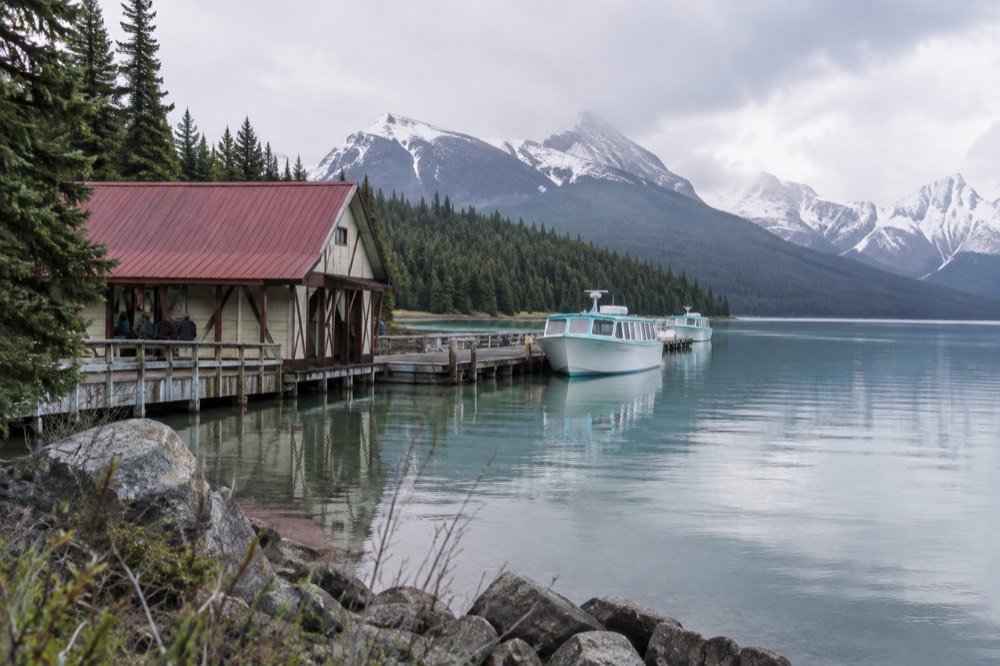
Whether that combination beats a pure morning wildlife run depends on your priorities. The 6-hour valley tour spreads its hours across a full day and includes the cruise; the 3-hour morning or evening watch concentrates all its hours on the window when bears actually feed. Serious bear-first visitors sometimes book the short dawn run and spend the afternoon driving the parkway themselves, which is a perfectly good strategy, since a pass is all you need to be on the road. The Maligne Lake cruise guide covers the cruise side of that decision in detail, and Jasper National Park Tours keeps the full roster of wildlife and valley products in one place.
Common questions about seeing bears in Jasper
How Likely Are You To See A Bear In Jasper?
There is no official sighting rate, so any percentage you read is invented. Bears are on Parks Canada's official Jasper mammal list, and visitors do see them, most often at dawn and dusk from the Maligne Lake Road, the Icefields Parkway and valley-bottom corridors. Your odds rise with hours spent in the right habitat at the right times, and with a guide who knows where the feeding grounds are.
What kind of bears live in Jasper National Park?
Both black bears and grizzly bears live in the park, and both appear on Parks Canada's official mammal list for Jasper. The park does not publish a population count for either species, so treat any specific number you encounter elsewhere with suspicion.
Is a wildlife tour a guarantee of seeing a bear?
No. A sighting is never a guarantee, and no honest operator claims one. What a tour provides is the right hours, the right habitat and a trained eye, which materially improves your odds compared with driving at random, but the animals decide the rest.
How close can you get to a bear in Jasper?
Parks Canada's rule is 100 metres from bears and other carnivores, about ten bus lengths, and 30 metres from elk, deer and moose. Stay in your vehicle at roadside sightings, never stop in a driving lane, and move on if a jam develops. Enticing, feeding or pursuing an animal, including with a camera, is an offence.
When is the best time of day to see a bear in Jasper?
Early morning and the last hours before dusk. Bears feed at the edges of the day and avoid midday traffic and heat, so the visitors who see them are overwhelmingly the ones on the road before 8 am or out after 6 pm. This is why the strongest wildlife tours are built around those windows.
Do I need bear spray for a walk in Jasper?
Parks Canada's trail guidance says to travel in groups, make noise, remove headphones and carry bear spray, and know how to use it. If you meet wildlife on foot, back away and return the way you came. The full prevention advice is on the park's wildlife safety pages, and it applies to guided and independent walkers alike.