What Are The Best Ways To Travel From Banff To Jasper?
The honest comparison of every way to get from Banff to Jasper: driving the Icefields Parkway, taking a guided tour, riding a coach, or connecting by rail, with verified distances, costs and seasonal facts.
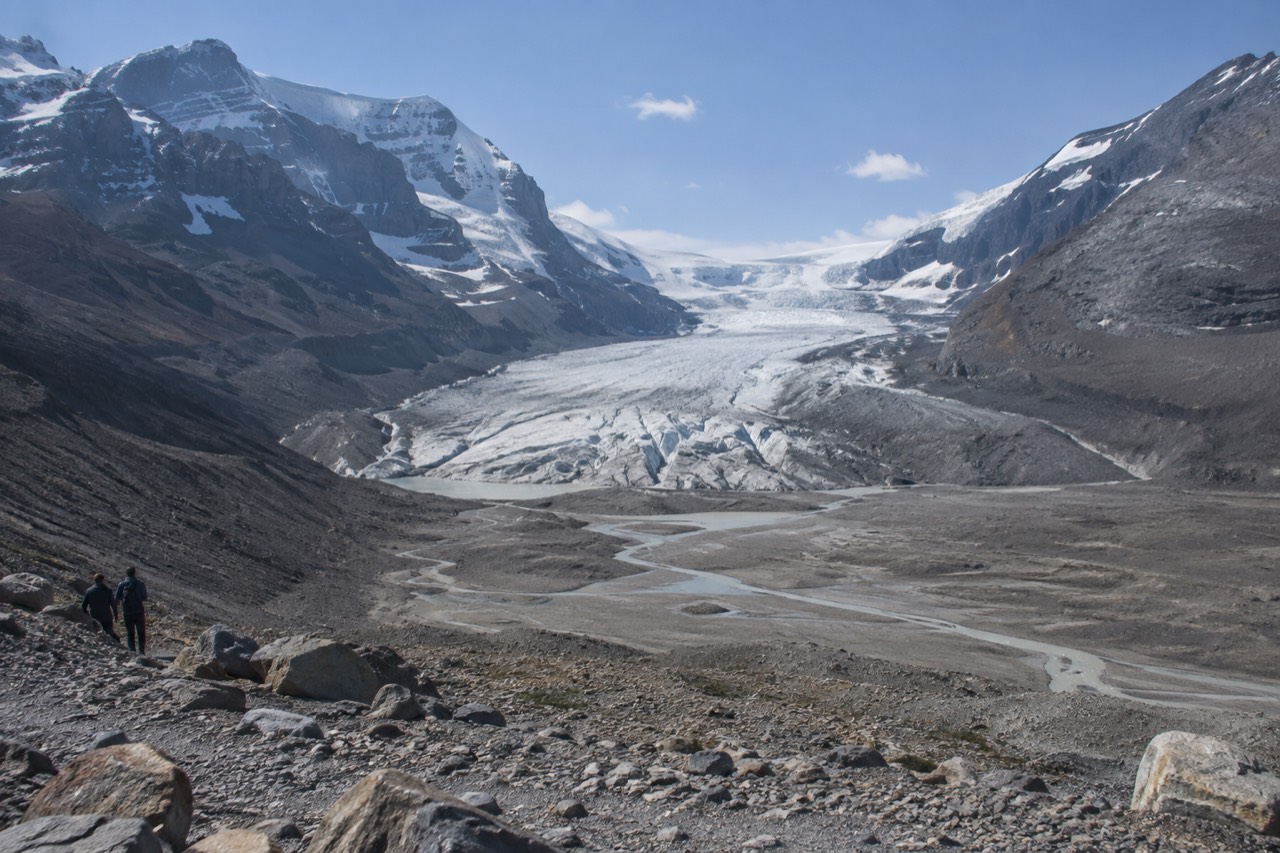
The 232 kilometres of the Icefields Parkway between Lake Louise and the Jasper townsite are the reason most people make this trip at all. It is one of the few routes in the world where the drive competes with the destination, and that single fact shapes every option worth comparing. A park pass is legally required to travel inside Jasper National Park, and the same pass covers Banff, so you do not buy two. What you are really choosing is who holds the wheel, how long you can stop, and whether you want the glacier, the falls and the wildlife interpreted for you or discovered on your own.
What Are The Best Ways To Travel From Banff To Jasper?
The best way to travel from Banff to Jasper is to drive yourself along the 232 km Icefields Parkway if you want maximum stopping flexibility, take a guided day tour if you would rather not drive the grades and winter conditions, or ride a scheduled coach if you have no car. There is no direct train from Banff, and flying connects only through Calgary or Edmonton. Each option suits a different traveller.
The honest answer is that "best" splits into three. If you have a vehicle, a licence comfort with mountain roads and a full day, self-driving wins on freedom. The Parkway has no timed entry, no mandatory shuttle and no reservation corridor, which is a genuine difference from Banff's Lake Louise and Moraine Lake system. You can stop at Bow Lake, Peyto Lake's viewpoint, the Columbia Icefield and both named falls without booking a seat on anything. The trade is responsibility: no cell coverage along much of the route, no winter services, and snow tires or chains legally required from 1 November to 31 March.
If you would rather not drive, a guided tour turns the transfer into the day's activity. The 10-hour Jasper to Banff tour runs the Parkway with stops at Athabasca Falls and Maligne Canyon, at from $212.2 per person with free cancellation. It is a one-way trip that solves travel and sightseeing in a single booking. The trade is pace: you stop where the itinerary stops.
The third option is the scheduled coach. Brewster Express runs coaches between Jasper and Banff along the Icefields Parkway, which is the closest thing to a public transit link the two towns have. It suits travellers without a car who are happy to watch the scenery pass.
Driving yourself: the Icefields Parkway option
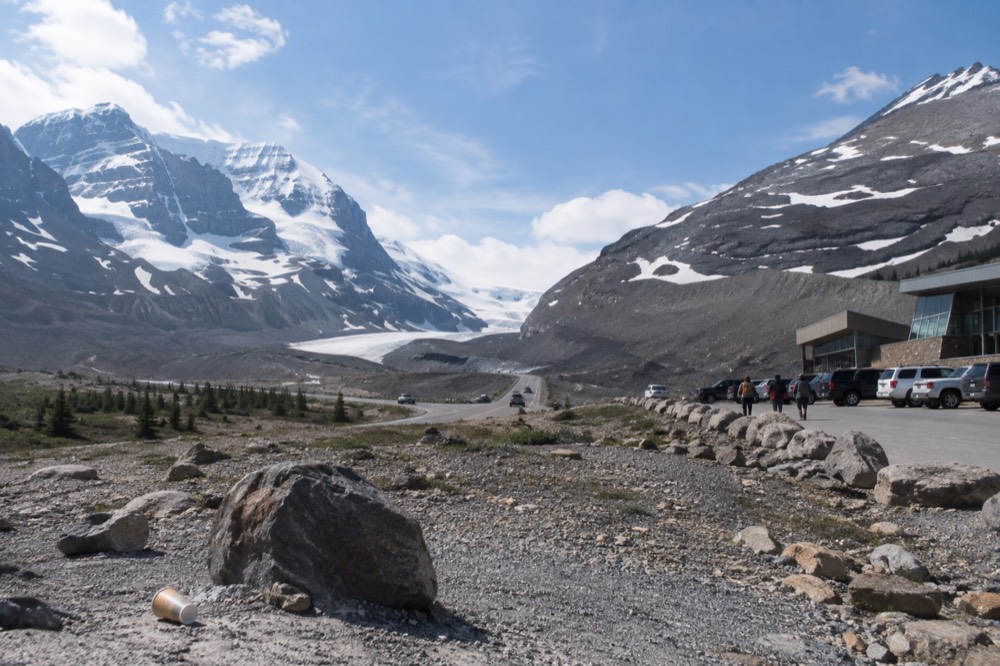
Driving yourself is the most flexible way to travel from Banff to Jasper, covering 232 km between Lake Louise and Jasper on a road that never closes for winter, though snow tires or chains are mandatory from 1 November to 31 March and there are no services en route in winter. The route passes Athabasca Falls, the Columbia Icefield and Sunwapta Falls, all with open day-use areas.
The Parkway is Highway 93 North, and Parks Canada publishes the distances between its major stops: Athabasca Falls sits 30 km from Jasper and 203 km from Lake Louise, Sunwapta Falls is 54 km from Jasper, and the Icefield Centre is 103 km south of Jasper. Those numbers matter for planning, because the temptation is to stop everywhere and the day disappears fast. A realistic self-drive with three or four proper stops takes most of a daylight day in summer.
The winter version is a different trip. Parks Canada maintains a dedicated winter driving page for the Parkway rather than a closure date, because the road stays open year round. Snow clearing runs 7 am to 3:30 pm, the road is not salted, so it is often compact snow, and long grades of 8 to 11 percent occur near Bow Lake and on the ascent and descent of Sunwapta Pass. There is no cell coverage en route, service exists only at each end, and a 20 km stretch runs through winter habitat for the Jasper herd of woodland caribou, a species at risk, which is why the speed limit drops in places.
Before you drive, check 511 Alberta at Alberta road conditions and Parks Canada's road restrictions and seasonal closures page. Parks Canada warns explicitly that navigation apps are not always accurate for Jasper National Park, which is worth believing: Highway 93A, the old Parkway parallel route, has weight restrictions and a roadwork window in autumn 2026 that apps may not reflect. Our full route breakdown lives in the Banff to Jasper drive guide.
| Travel option | Route | Best for | Main trade-off |
|---|---|---|---|
| Self-drive | 232 km Icefields Parkway, 3-4 stops realistic | Freedom to stop anywhere, photographers | You drive 8-11% grades; no winter services; no cell coverage |
| Guided day tour | Parkway with fixed stops including Athabasca Falls | No driving, interpretation included | Fixed itinerary and pace |
| Scheduled coach | Jasper to Banff coach along the Parkway | Car-free travellers | Few or no sightseeing stops |
| Train | Via Rail serves Jasper from Edmonton and Vancouver only | Scenic arrival from far away | No rail link from Banff at all |
Taking a guided tour instead of driving
A guided tour is the best way to travel from Banff to Jasper if you want the drive interpreted rather than just completed. The 10-hour Jasper to Banff day tour costs from $212.2, scores 5 across a small number of reviews, and stops at Athabasca Falls, Maligne Canyon and the Banff townsite, with free cancellation. It converts travel time into sightseeing time.
The economics are more reasonable than they first look. A one-way rental car between Banff and Jasper carries a drop fee that often exceeds the tour price, and the tour includes a driver who knows where the wildlife actually is. The confirmed stops on the Jasper to Banff itinerary are the Jasper townsite, Maligne Canyon, Athabasca Falls and the Banff townsite, and the listing runs 10 hours with free cancellation. One honest note: Maligne Canyon itself is closed to all access for the 2026 season, so confirm with the operator how that stop is handled before you book.
The guided option also covers the winter question for you. A commercial operator running the Parkway in January is equipped for the compact-snow conditions and the chain requirement, and the driver watches the road while you watch the peaks. For anyone nervous about the grades near Bow Lake or the Sunwapta Pass descent, that peace of mind is the product.
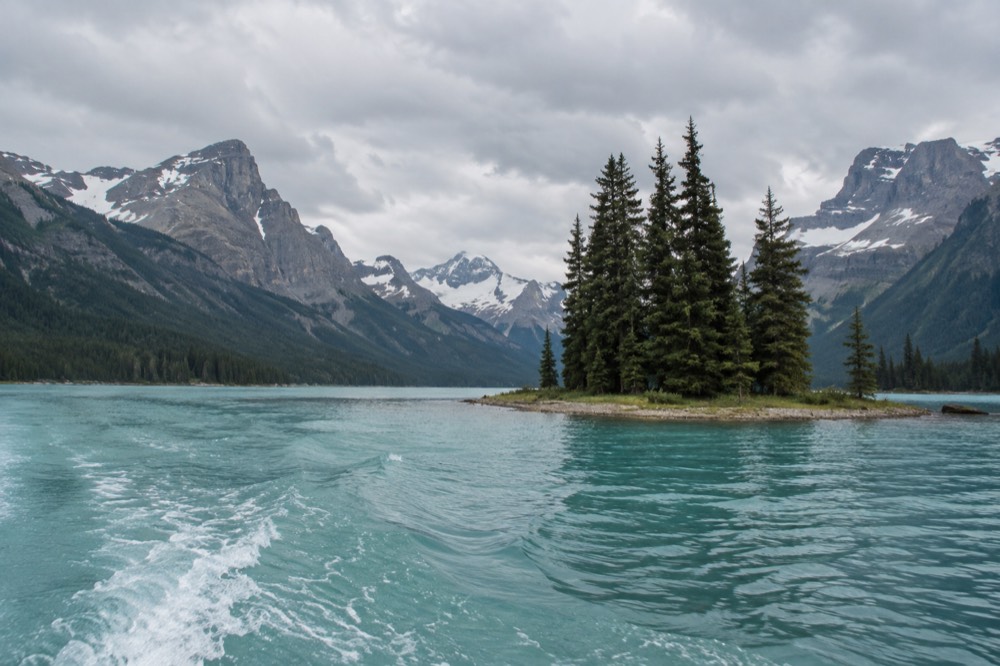
Once you are in Jasper, the same logic applies to days you would otherwise spend finding your own way around. The Maligne Valley is the classic case: a guided tour covers Medicine Lake, the Maligne Lake boathouse and Spirit Island in one loop from town.
What the drive actually passes
The Icefields Parkway between Banff and Jasper passes the Columbia Icefield, the largest icefield in the Canadian Rockies at more than 300 square kilometres, plus Athabasca Falls, Sunwapta Falls and a 20 km stretch of caribou winter habitat. The Athabasca Glacier has receded for 125 years, and Jasper lost 21.8 percent of its glacier mass between 1985 and 2024.
The centrepiece stop is the Columbia Icefield, 103 km south of Jasper on Highway 93. The Athabasca Glacier spills from it across three bedrock steps, and Parks Canada calls it Canada's most accessible glacier. The numbers behind the scenery are sobering and worth knowing before you stand at the toe: from 1985 to 2024, Jasper lost 21.8 percent of its total glacier mass, the Columbia Icefield alone lost nearly 13.3 percent over the same period, and from 2017 to 2024 the icefield lost about 1.5 cubic kilometres of ice, a volume Parks Canada compares to nearly 590,000 Olympic swimming pools. In 1985 Jasper had 299 glaciers; by 2021 it had 392, which is not growth but large glaciers fragmenting into smaller ones as they melt. Other pages covering the same trip are gathered on Jasper National Park Tours.
Athabasca Falls, 30 km from Jasper, is 23 metres high and, in Parks Canada's words, not very high by Canadian Rockies standards, but the size of the river makes it one of the most powerful falls in the mountain national parks. Sunwapta Falls, 54 km from Jasper, is a stepping waterfall where a hanging valley meets the Athabasca Valley, and the trail beyond it passes through the Chaba River burn, the legacy of a 1967 wildfire that is now some of the best bear and moose habitat in the park. Both day-use areas are open.
The 2024 wildfire is visible along parts of the route too. The burn ran north up the Athabasca valley south of town and reached the townsite's southwest edge, and regrowth is under way. Parks Canada's own summary is that the majority of the park is now open and ready to explore, and virtually all of Jasper's trails have reopened. The Icefields Parkway tours guide covers each stop in detail.
Coaches, shuttles and the car-free route
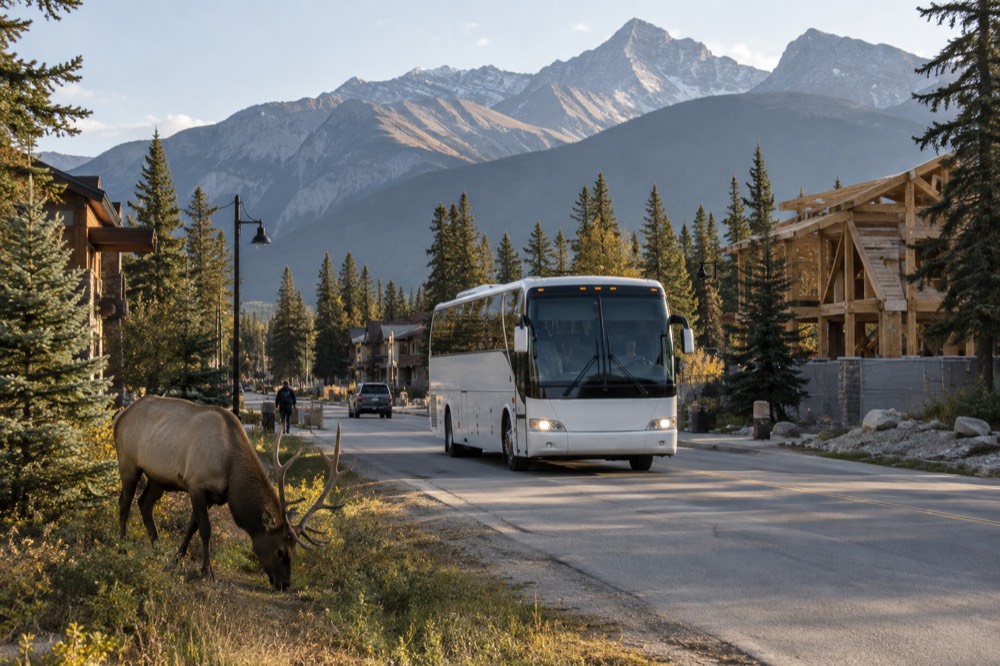
For car-free travellers, Brewster Express runs scheduled coaches between Jasper and Banff along the Icefields Parkway, which is the only direct public-transport link between the two towns. There is no mandatory shuttle inside Jasper and no timed-entry reservation, unlike Banff's Lake Louise system, so once you arrive you can travel anywhere in the park on a park pass alone.
The coach option is slower and less flexible than driving but it removes the two hardest parts of the journey: the winter tire requirement and the no-cell-coverage problem. It also drops you in the Jasper townsite, which is genuinely walkable, with the Jasper Information Centre at 500 Connaught Drive open 9 am to 7 pm through the summer season. From Jasper, local tour operators run hotel pickup, so a car-free trip is entirely workable: coach up, tours out.
The pass question comes up here. A day pass is charged per person, at $12.25 CAD for an adult, with a Family/Group rate of $24.50 CAD covering up to seven people in one vehicle, and the same pass admits you to both Banff and Jasper on the same day. Youth 17 and under enter free. The pass must be printed and displayed on the dash. Whether a commercial tour absorbs the entry fee or leaves you to buy your own is an operator-by-operator decision, and each tour's inclusions list is the only authority. The details are in our Jasper National Park entry fee guide, and the current figures are on the Parks Canada fee page.
Why there is no train from Banff
There is no passenger train from Banff to Jasper. Via Rail serves Jasper from Edmonton and Vancouver only, so rail is an arrival option from far afield, not a connection between the two mountain towns. Anyone suggesting a Banff to Jasper train is describing a sightseeing bus or a historic route that no longer carries passengers.
This is worth stating plainly because search results are full of confusion on it. The nearest you get is arriving in Jasper on Via Rail from Vancouver or Edmonton and treating the train as part of the adventure. Jasper is 370 km west of Edmonton and 805 km northeast of Vancouver by road, and the rail line follows its own corridor. From Banff, nothing on rails runs north.
The practical implication for itinerary planning: if you are flying in, Calgary is 404 km from Jasper and Edmonton is 370 km, and the Edmonton route is both shorter and flatter. SunDog Transportation and Tours runs a daily Jasper to Edmonton connector shuttle, and Brewster Express connects Jasper and Banff. A fly-into-Calgary, drive-up-the-Parkway, fly-out-of-Edmonton loop is the pattern that minimises backtracking.
Which option fits which traveller
Families and photographers should self-drive, because the Family/Group park rate of $24.50 CAD caps entry costs and the stops are the point. Solo travellers and anyone avoiding mountain driving should take the guided tour or the coach. Winter travellers should take a guided tour or wait for summer, since the Parkway has no services, no cell coverage and a legal snow tire requirement from November to March.
For families, the arithmetic is decisive. Two adults already hit the $24.50 Family/Group cap, and youth 17 and under are free, so a carload of five pays the same as a couple. Add the freedom to linger at the Athabasca Falls potholes or stay for the light on Sunwapta Falls, and self-driving is hard to beat. The one caution is vehicle size: several side roads, including the Miette Road and the Toe of the Glacier Road, cap vehicle length at 7.5 metres, so a large motorhome should stay on the Parkway itself.
For winter travellers, the guided option is safer and better informed. The Parkway in January is compact snow, unsalted, with plows working 7 am to 3:30 pm and nothing open between the two towns. A commercial driver who runs that road weekly is not a luxury, and the same booking removes the chain requirement from your packing list.
For anyone whose real goal is the Maligne Valley, the strongest use of a Jasper day is the Wildlife and Sightseeing Tour with Maligne Cruise: 6 hours from $169.04, rated 4.8 across 665 reviews, with hotel pickup and free cancellation, covering Patricia Lake, Medicine Lake, Spirit Island and the Whistlers summit. It pairs a wildlife drive with the Spirit Island cruise, which is the only practical way to reach the island, since Parks Canada states plainly that there is no road or trail access and tour boats or private non-motorized craft are the only means of getting there.
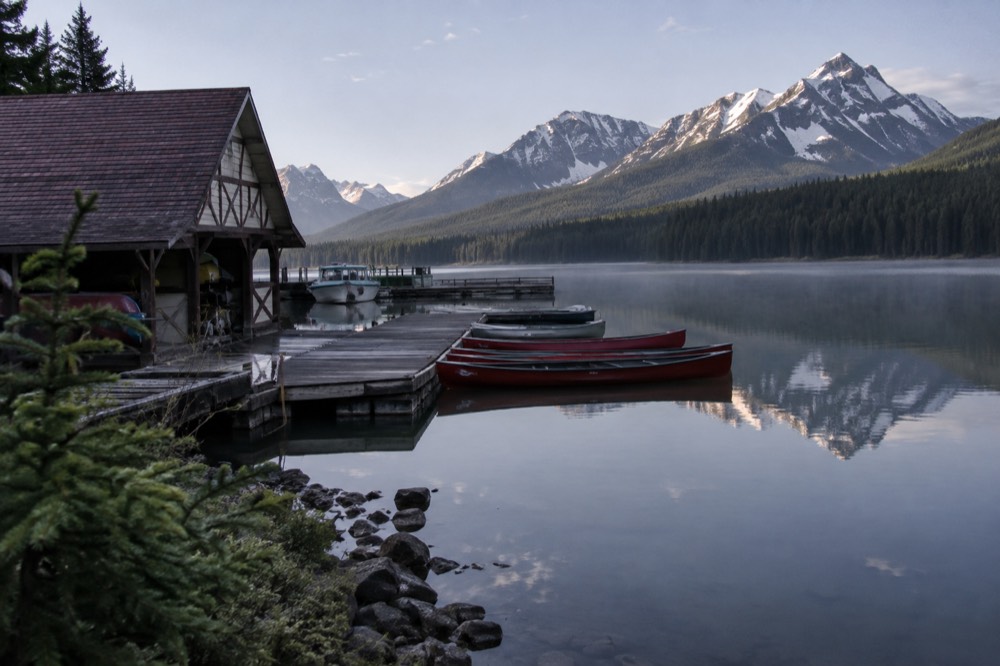
The Maligne Lake Cruise itself runs 27 May to 11 October, weather dependent, and Pursuit advises allowing at least 90 minutes for the drive from Jasper to the lake and arriving about an hour before your cruise time. Missed cruises are non-refundable with limited rebooking, so if you self-drive to the lake rather than taking a tour, build in real buffer. The operator's own cruise page carries the current schedule.
Common questions about travelling from Banff to Jasper
What Are The Best Ways To Travel From Banff To Jasper?
Drive the 232 km Icefields Parkway yourself for maximum flexibility, take a 10-hour guided day tour from $212.2 if you would rather not drive, or ride the scheduled Brewster Express coach if you have no car. There is no train from Banff; Via Rail reaches Jasper only from Edmonton and Vancouver.
How far is Jasper from Banff by road?
The Icefields Parkway between Lake Louise and the Jasper townsite is 232 km. Athabasca Falls sits 203 km from Lake Louise along the route, and the Icefield Centre is 103 km south of Jasper. No primary source publishes a driving time, so plan the day around stops rather than an hour figure.
Do I need a park pass to drive between Banff and Jasper?
Yes. A park pass is legally required to travel inside Jasper National Park, and the same day pass covers Banff, Jasper, Yoho, Kootenay and the other mountain parks. Adult day admission is $12.25 CAD, the Family/Group rate is $24.50 CAD for up to seven people in one vehicle, and youth 17 and under are free.
Is the Icefields Parkway open in winter?
Yes, the Parkway has no seasonal closure. From 1 November to 31 March, or whenever the road is snow-covered, vehicles must have snow tires or chains. There are no services along it in winter, it is not salted, and there is no cell coverage en route. Check 511 Alberta before you drive.
Can I get from Banff to Jasper without a car?
Yes. Brewster Express runs scheduled coaches between Banff and Jasper along the Icefields Parkway, and once in Jasper, local tours with hotel pickup cover the Maligne Valley, wildlife watching and the lake cruise. Jasper's townsite itself is walkable.
Is there a shuttle or timed entry I need to book in Jasper?
No. Jasper has no timed entry system, no reserved-access corridor and no mandatory shuttle for any attraction, unlike Banff's Lake Louise and Moraine Lake system. The only authorization needed to travel anywhere in the park is a park pass.